
CFD Analysis of Emergency Closure in a Hydraulic Intake System
Three-dimensional CFD modeling to assess transient hydraulics, gate loads, and cavitation risk during emergency closure operations in a hydraulic intake system.

Overview
A large hydraulic intake system equipped with a vertical slide gate required a technical evaluation of whether an emergency closure under flow conditions could be performed safely. Although the gate was originally intended for operation under no-flow conditions, operational scenarios made it necessary to understand its behavior when closing against an active discharge.
HCS conducted a detailed three-dimensional CFD study to characterize flow transients, pressure distributions, and hydrodynamic forces acting on the gate throughout the closure process. The analysis provided a defensible technical basis for assessing operational feasibility and associated risks.
The Challenge
Emergency gate closure under flow involves complex hydraulic phenomena, including:
- Rapid changes in flow constriction
- Strong pressure gradients upstream and downstream of the gate
- Interaction between water flow and ventilation air
- Transient hydrodynamic loads acting on structural components
- High local velocities with potential for cavitation
The project required answers to several key questions:
- Under which operating conditions can emergency closure be performed safely
- How hydrodynamic forces evolve as the gate moves
- Whether pressure conditions could lead to cavitation
- How sensitive the system response is to the closure speed
- Whether geometric details of the gate significantly influence load predictions
Addressing these issues demanded a high-fidelity numerical approach capable of resolving transient, multiphase flow with moving boundaries.
Our Contribution
1. Three-Dimensional CFD Modeling Framework
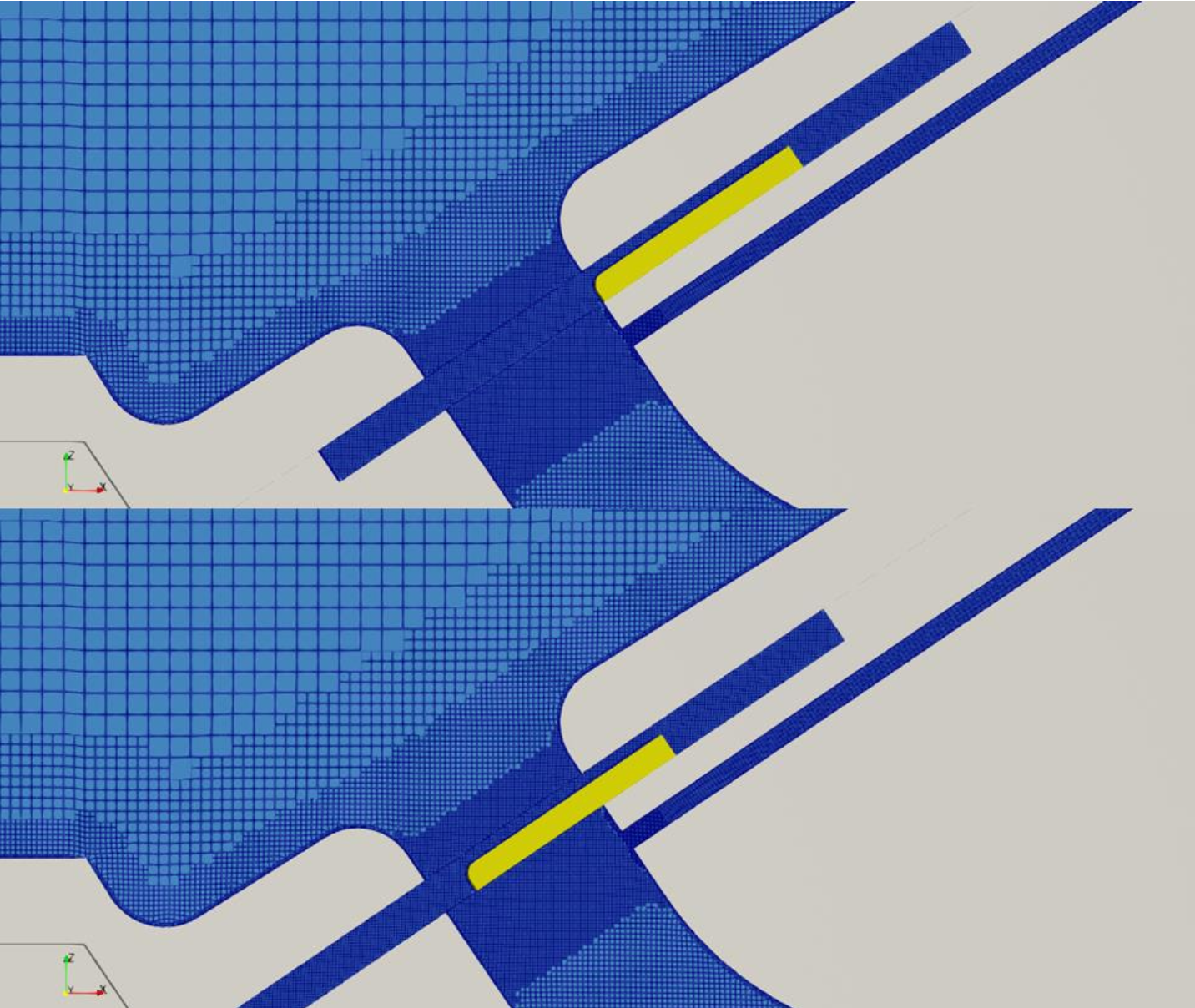
HCS developed a full 3D CFD model of the intake system, including the gate, tunnel, and ventilation duct. The modeling approach incorporated:
- Reynolds-averaged turbulence modeling
- A free-surface formulation to represent air–water interaction
- Moving-mesh techniques to capture the gate motion
- Local mesh refinement in regions with strong gradients
The model was designed to resolve both global hydraulic behavior and localized phenomena near the gate lips and slots.
2. Operating Scenarios and Closure Strategy
Multiple operating flow conditions were analyzed to represent the full operational envelope of the intake system. For each condition, simulations were initialized in steady state before triggering the gate motion.
To manage computational cost while capturing transient behavior, a staged closure strategy was applied. Accelerated closure simulations were first used to identify critical flow features, followed by simulations representing the real operational closure rate. This approach ensured that the final conclusions reflected realistic operating conditions.
3. Transient Hydrodynamic Behavior
The CFD simulations showed that, for realistic closure speeds, the hydraulic response of the system evolves in a quasi-stationary manner. Flow redistribution, pressure variations, and air entrainment adjust progressively as the gate closes, without inducing extreme transient effects.
Faster, non-representative closure rates were found to amplify transient pressure fluctuations and localized low-pressure zones. However, these behaviors were not considered relevant for actual operation and were used only as sensitivity tests.
4. Hydrodynamic Forces on the Gate
The analysis focused on two key force components acting on the gate:
- The normal force associated with upstream hydrostatic loading
- The downpull force generated by flow acceleration beneath the gate
The model results confirmed that:
- Normal forces remain consistent with hydrostatic expectations throughout closure
- Downpull forces exhibit a clear transient peak but stabilize as the gate approaches its closed position
The corrected force estimates provided a more accurate and conservative basis for evaluating structural and mechanical safety.
5. Cavitation Risk Evaluation
The CFD results indicated that very high velocities develop locally near the gate during closure, particularly in the final stages. Under certain operating conditions, these velocities can generate pressure reductions consistent with localized cavitation onset.
However, the analysis also showed that:
- Low-pressure regions are spatially limited
- Their duration is short during the closure process
- Air entrainment through the ventilation system mitigates cavitation severity
As a result, any cavitation expected during emergency closure is likely to be superficial and transient, rather than structurally damaging.
Key Findings
The integrated CFD assessment demonstrated that:
- Emergency closure under flow can be evaluated reliably using high-resolution 3D modeling
- System behavior during realistic closure is dominated by quasi-stationary hydraulics
- Hydrodynamic loads on the gate remain within predictable and manageable bounds
- Cavitation risk is localized and limited under realistic operating conditions
These findings provide a technically sound basis for assessing emergency operation scenarios.
Outcomes and Client Value
Through this study, HCS delivered:
- A validated CFD framework for analyzing moving-gate hydraulics
- Quantitative insight into transient pressures and structural loads
- Improved confidence in emergency operating procedures
- A clear understanding of cavitation mechanisms and their practical implications
- A defensible technical foundation for operational decision-making
This project illustrates HCS’s capability to apply advanced CFD techniques to complex hydraulic systems involving transient flow, air–water interaction, and moving boundaries.
Contact
Request a consultation
Have a hydraulic challenge? Let's discuss how we can help.
Call Us
+54 2324 550433